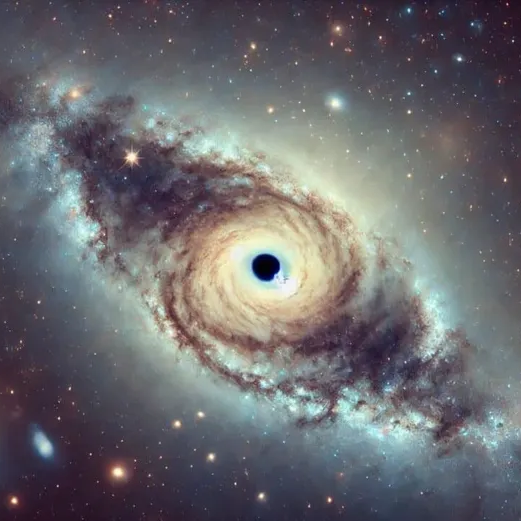
Galaxies
Galaxies are clusters of stars, stellar remnants, interstellar gas, dust, and dark matter, all bound together by gravity.
Galaxies come in various shapes and sizes. Below are some of the main types:
1. Spiral
These galaxies have a flat, rotating disk with spiral arms emanating from a central bulge. Examples include the Milky Way.
2. Elliptical
These galaxies are shaped like ellipses and lack distinct spiral arms. They are the largest galaxies in the universe.
3. Irregular
These galaxies do not have a regular shape and are often composed of older, redder stars. They are the smallest galaxies.
4. Lenticular
A transitional form between spiral and elliptical galaxies, with a disk and a central bulge but no prominent spiral arms.
5. Active
These galaxies have exceptionally energetic centers, often due to supermassive black holes. These include Seyfert galaxies, quasars, and blazars.